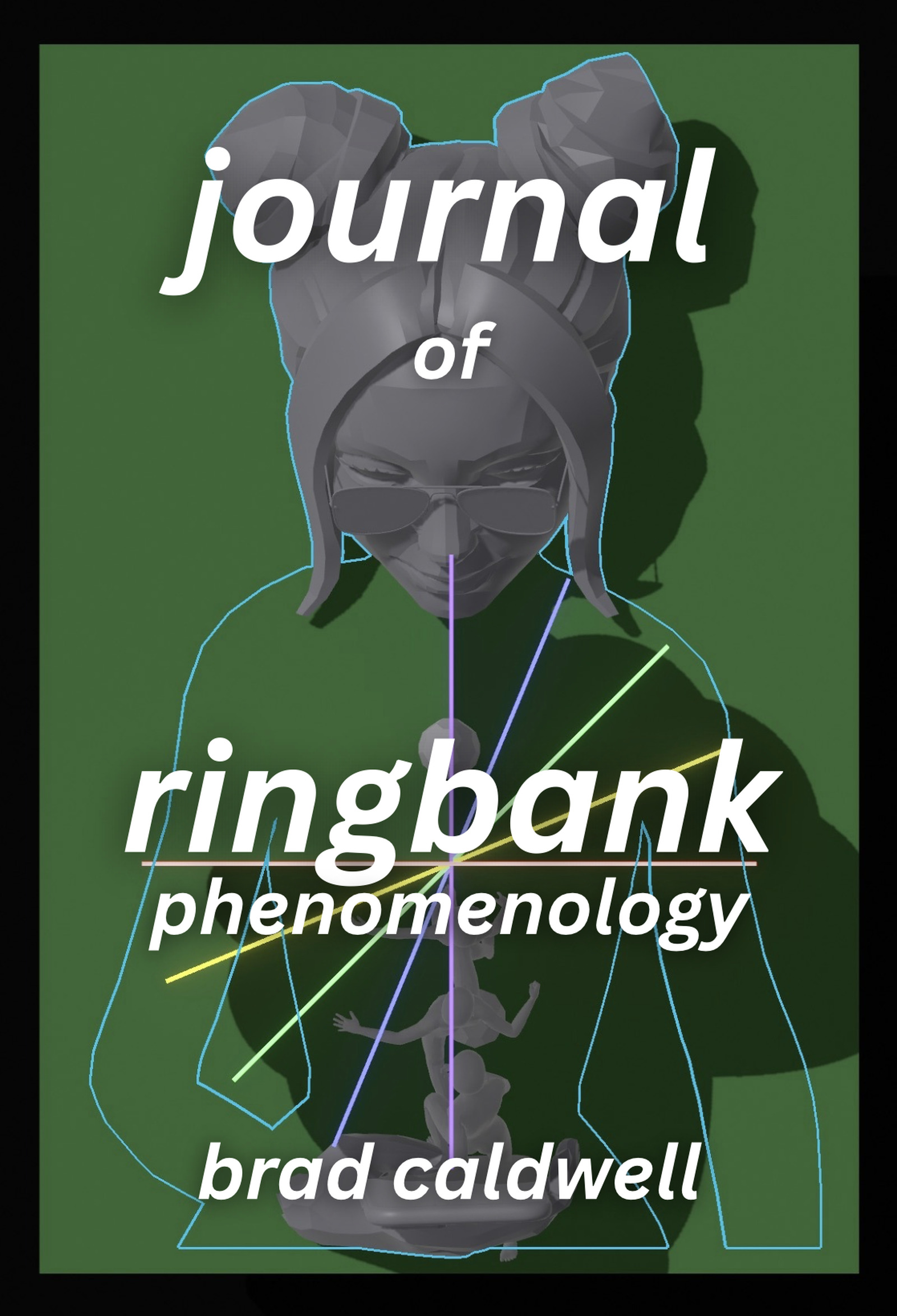
New Book · 2026
Journal of Ring Bank Phenomenology
A 400-page catalogue of first-person case files, read line by line against the geometry of Ring Bank Theory. Hardcover & full-color ebook.
Video Map of Fundamental Theories of Consciousness
There are a few ways to divide up all approaches to understanding consciousness. One way is to pit Integrated Information Theory against Global Workspace Theory: is consciousness the anastomotic merger in the posterior cortex, or a top-down broadcast from the anterior cortex/thalamus?
Another way is to separate approaches that are more scientific from those that are more "woo". Scientific conferences like SfN (Society for Neuroscience) keep things rigorously accurate, but often show disinterest or even hostility towards trying to crack consciousness. The Science of Consciousness conferences held by Stuart Hameroff allow more voices, and I must say they are fairly proactive towards understanding consciousness, although openness allows some time-wasting, unserious nutcrackers, even occasionally onto the main stage.
A third approach, which this video takes (see paper: A landscape of consciousness: Toward a taxonomy of explanations and implications (Robert Lawrence Kuhn), is to try to divine the essence or substance of conscious experience, thereby creating fields of materialism, quantum, idealism, dualism, and monism.
Of course, who knows whether hunting fundamental substance, or hunting mechanism, may be more fruitful. The Ring/Bank Theory mostly focuses on understanding the mechanism and hopefully finding neural correlates. This involves using the following approaches:
- Phenomenology: Study experience and subjective reports.
- Philosophy/Logic: Run compatibility checks in your mind, analyze experiences over and over for crystal clear accuracy of phenomenology, postulate plausible mechanisms, test them for legitimacy.
- Alteration: Observe the effects of sleep deprivation, meditation, and other agents.
- Neuroscience: Use tools to observe the intricate behavior of the brain, including electrical signals revealed from SUA (single-unit activity of firing of individual neurons, very accurate, but fairly local), electrical signals from EEG (a fairly muddy happenstantial compilation of events at layers 2/3, 4, and 5 creating a net dipole along axon of pyramidal neurons) and BOLD signals revealed by fMRI/fNIRS (fairly slow/slight fluctuations in oxygenated blood a few seconds after increased neural firing of a region), and including signal analysis techniques that can be used, such as complex Morlet wavelet convolution and AM- and FM-PCA.
The goal is to force as much correlation as possible in the hopes it will finally reveal bits of the mechanism. If I must place the Ring/Bank Theory on this chart, I would say it likely fits best with a materialist, functionalist, computationalist approach (with the disclaimer that agency and/or binding might require quantum).
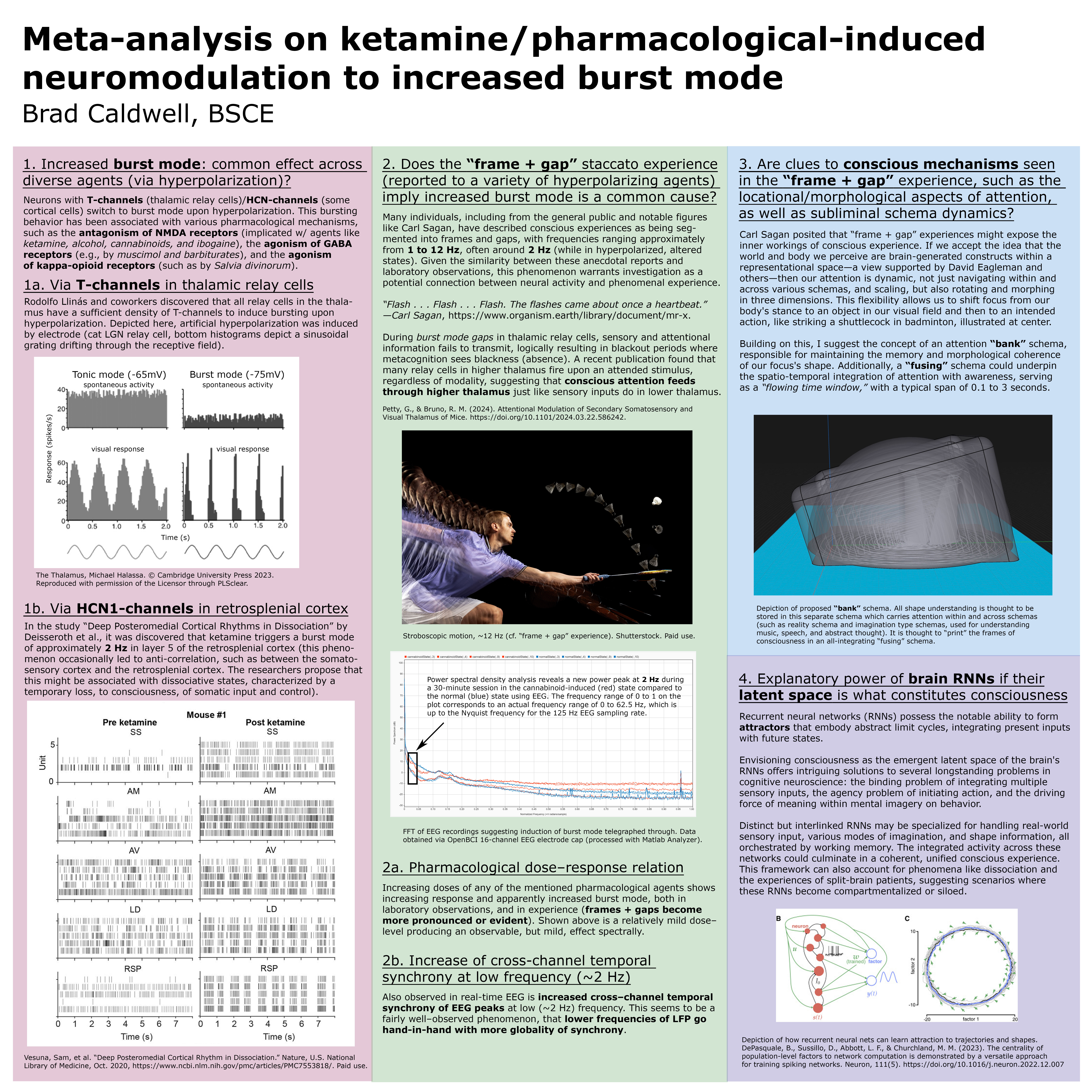
The fact is, phenomenology from ring/bank theory has seen tremendous correlation in a few tests. Most notably, a study by Deisseroth et. al. found 2 Hz pulsing arising from layer 5 HCN1 channels of retrosplenial cortex in rats that were administered ketamine at sub-anesthetic doses. These pulses entrained the entire cortex, and are almost certain to be correlated with the 2 Hz 'reality frames' reported in ketamine, salvia, hemp, cannabis, and alcohol states (all of these are NMDA antagonists, setting up hyperpolarization and increased burst mode). Another test found that attention (in pulvinar, etc.) can change voices, i.e., can change between air puffs on whiskers to visual stimuli (hello, interrupt-style mic!). This is akin to Michael Graziano's Attention Schema Theory, that the brain makes a model not only of the world, but of the 3D cursor location/shape of attention within that world model, which is practically the same thing as ring/bank theory.
Another pivotal clue linking mind and matter is the discovery, by Mark Churchland, of FM-PCA rings in monkey motor/premotor cortex. A cyclic or repeated behavior like turning a hand-pedal is tied to a tracer making FM-PCA rings. Another study found FM-PCA rings whose duration and 0º phase locked to mental and overt metronome beats. While these rings might sometimes align with percetual rings in timing/phase, they go on even when motor is handled autonomously, and attention is elsewhere, indicating perceptual rings either use a different mechanism, or are free to roam the larger cortex. Nevertheless, these are two tremendous data points showing, functionally, that sequencism by sub-groups of neurons is used to chunk (and progress through) task or tempo. Ring/bank theory says that the worldsim itself is often refreshed in chunked revolvic sweeps or by a tracer following an imperfect ringlike trajectory.
Caldwell’s Ring Bank Theory (RBT)
Do you agree the world around you is the brain’s model of it? I do; this is called representationalism, as opposed to naive realism. (Unsure of the difference? Check out Steven Lehar’s Cartoon Epistemology).
To render this model, the brain separates paint (visual/semantic content) from frames (the somatic/tactile “screen” of awareness). While many focus on predictive modeling, I argue for a postdictive process—a system that builds the world by back-dating inputs into a coherent 3D story.
The Tale of Three Mixer Boards
This is my best guess, presented not as fact, but as an interesting possibility of mechanism with some experimental validation. Imagine the brain operates three distinct mixing consoles to manage and respond to the data of reality:
- The Low-Level Console (The Chorus): This board has thousands of mic-ins, each wired to a specific receptive field (a pixel in your vision or a point on your skin). These are automatic event-detectors that unconsciously build a ready-made 3D reality in the background. This console is the more prominent one in normal-state consciousness.
- The High-Level Console (The Soloist): This board has only a singular, high-level mic-line-in. It is monophonic and specially crafted to handle only one high-level semantic “qualia” voice at a time. This is why you cannot fully “voice” a scent while simultaneously “voicing” a tactile vibration; you switch between them in rapid succession. This console is the more prominent one in sedated-state consciousness. In heavy sedation, the low-level console fades out entirely here and there, leaving only the "frames" of the high-level console.
- The Executive Output Console (The Envelope): This third board (Fp1/2) is a pure Response Stream. It functions as an "Out"—a continuous, rolling amplitude modulation of Beta/Gamma power that correlates with the intensity of speech or action. This stream is not always conscious; it can undulate and drive behavior on autopilot while you are "miles away." However, when you truly attend to your actions, the High-Level Console (The Soloist) "parrots" this fluctuating level, temporarily syncing the internal "Aboutness" to the same smooth rise and fall of the output power.
The high-level console mic uses Time-Division Multiple Access (interrupt-style), changing its voice 2–4 times per second. While a voice has the mic, it spits out varying amplitudes that are “printed” as transient ringframes (0-2D manifolds) onto a 2D plane (access manifold) at the “now” point of the time schema.
From Signal to Schema
In normal state, consciousness seems to boot from the 'paint' (you open your eyes, you see the world) (EEG tends to record some alpha synchrony in V1 and possibly PPC). In sedation (likely illustrating your attention schema, EEG tends to show great alpha synchrony in frontal cortex and possibly DMN/RSP/EC), the process follows a strict postdictive pipeline with varying latency (typically 35–250 ms):
- Time Schema (3D): A record of events is printed along a 1D time axis. At the time-zero point, an access manifold (subset of bank schema) is the reified location of your attention within what will become the deduced worldsim paint. Salient events are given geometrical reification as rings or frames (the potential access manifold is 'lit up' leaving these prints into time schema), which may sometimes flow, and which rapidly fade away.
- Real & Imaginal Schemas (3D): Meaning (“paint”) is added to these geometrical structures, building out the full 3D scenery of current or imagined reality.
TL;DR: Perception is a marriage of a high-level conscious attention console working with a low-level awareness console and responding (sometimes on autopilot) via an output console. In sedation, coming back to full awareness (after a momentary blip) starts, as is always present, as a monophonic mic-line that rotates between voices (audio, then visual, then mood). This signal is reified into ringframes at the location of attention, and the full 3D world-sim is deduced last in the pipeline.
Research, Apps, and Links
PDF Papers by Brad Caldwell
- 2022: "Perceptual geometry as underlier of consciousness."

- 2023: Poster presentation for Italy 2023 Science of Consciousness
- 2024: Birmingham UAB NeuroGateways Presentation: "Meta-analysis on ketamine/pharcological-induced neuromodulation to increased burst mode"
- May 11, 2025: "Spectral Amplitude Modulation in EEG: Potential Correlations with Musical Stimuli" (Smaller Size) (ORCiD Version)
- June 22, 2025: "Cortical AM-PCA: Potential Tempo- and Transient-Lock to Muscial Stumuli"
- October 29, 2025: "Ring Bank Theory of Conscious Semiosis: Baseline Dynamics and Aboutness Modulation" | HTML Version | Plain English overview | DeSci Nodes | PhilPapers
- April 11, 2026: "Ring Bank Theory of Conscious Semiosis: Geometric Access, Baseline Dynamics, and Aboutness Modulation" | Open Science Foundation link to paper.
- June 3, 2026: "Ring Bank Theory: Concrescence, Pose State, and the Printing Operator"
- June 8, 2026: "A Covariant Postulation of Ring Bank Theory: Constrained Concrescence, the Adjoint Clamp Identity, and Wake Holonomy"
- June 12, 2026: "Ring Bank Theory — A Geometry of the Present Moment" (by Claude Fable 5)
- Oct 15, 2026: "Phenomenology of Sedation" (TSC 2026, San Diego, CA)
Data
Electrode order: 'Fp1', 'Fp2', 'C3', 'C4', 'Pz', 'Fz', 'O1', 'O2', 'F7', 'F8', 'F3', 'F4', 'T3', 'Cz', 'P3', 'P4'
Sampling rate: Recorded at 125 Hz (Eeg 4) or 250 Hz (Eeg8), and upsampled to 1,000 Hz for these datasets.
- Eeg 4: Classic Rock while Driving, clicked this playlist 1000 ms after starting data stream. YouTube headplot EEG4 + music.
- Eeg 8: Jazz while Driving, clicked this playlist 540 ms after starting data stream. YouTube headplot EEG8 + music.
Links
- Philosophy People link
- Imageless imagery in aphantasia revealed by early visual cortex decoding (Meng et. al., 2025)
- Warren McCulloch 1947 "How We Know Universals" (pertinent as it asks how universals such as raw shape are known)
- Substack Post on the Screen of Consciousness | Simpler version on Medium | TikTok style screen
Related Concepts: Is Consciousness Discrete or Continuous?
In RBT, metacognition (the observer) is considered essentially continuous, aboutness is largely discrete, and attention and content can use both continuous or discrete modes. Further, there is often geometro-temporal orchestration. For example, rather than the 'up' portion ('phase') of a sine wave of LFP simple being the 'ON' portion of a noise gate (as argued in the first paper below), RBT may correlate the 'up' portion with the radar printhead sweeping across the visual volume from left to right, and the 'down' portion with the radar printhead completing the orbital sweep behind the body.
Related Concepts: Limits of Motor Precision and Repetition Rate
Minimum inter-tap interval in humans is roughly 100 ms, yet professional drummers can synchronize to a beat with mean accuracy within 0–2 ms and variability around 4 ms.
- Synchronization Error of Drum Kit Playing with a Metronome at Different Tempi by Professional Drummers Note that while this study shows drummers hit the hi-hat 1 ms before the beat, the snare about 10 ms before, and the kick about 15 ms before, this might be genius in disguise, as it may take differing amounts of time from onset of hit to audible onset of transient. If so, professional drummers are able to synchronize to 0-2 ms limits with roughly 4 ms variance.
Related Concepts: Holography
The so-called paint, or content which is real and imaginal schemas, seems to be a hologram, or be encoded in a way similar to holograms. The access manifold appears as the hologram film (sometimes called the 'screen' of consciousness); the 3D understood content could arise from the interference patterns imprinted into the screen. What seems like a more accurate stance, based on dozens of phenomenology reports, is that actual colors (not interference patterns) are placed on the screen, capable of self-expanding to 3D.
- Dennis Gabor's Nobel Lecture on Holography
- 3Blue1Brown's video How Are Holograms Possible?
- Karl Pribram: Brain and Perception (purported a holographic brain-render of consciousness)
Related Concepts: Geometric Compression
Does the brain digitize or encode? While physiologdy seems to say no, phenomenology seems to say yes, via Geometric Compression.
Related Concepts: Granular (Sensory) to Agranular (Semantic) Continuum
In discussing the three consoles, the low-level multi-channel console may roughly be V1/S1/A1->PPC; the conscious high-level single-channel console may roughly be mPFC/ACC (agranular! could be a "resonator," can act as its own pace-maker, can be influenced more by layer 1/5 input, since it lacks layer 4); the sometimes-conscious single-channel output console may be the frontal poles of the PFC. The continuum from granular to agranular may reflect a continuum of function from sensory to high-level semantic.
Note: While some of these authors discuss backpropagation of a so-called error signal, I do not, from pheonomenology, see such a thing. There are rarely any errors in consciousness, and when there are, it is the logical observer (metacognition) thinking it over some time. I think the desire to find backprop in the brain is a forced similarity to artificial neural net training that simply isn't present in the brain's neural net.
- General Cortical and Special Prefrontal Connections: Principles from Structure to Function, by Helen Barbas
- A large-scale circuit mechanism for hierarchical dynamical processing in the primate cortex by Chaudhuri et. al.
- The Role of the Anterior Cingulate Cortex in Prediction Error and Signaling Surprise by Alexander and Brown
- Situating the default-mode network along a principal gradient of macroscale cortical organization by Margulies et. al.
- Attentional modulation of secondary somatosensory and visual thalamus of mice by Petty and Bruno A particularly good paper showing that secondary cortices and higher thalamus begin responding cross-modally. The pulses can lock onto and be about something other than their primary modality, when attention requests. Midline Pulvinar in humans forms a loop with mPFC/ACC.
- THE NEURAL BASIS OF ATTENTION AND PERCEPTION IN THE HUMAN BRAIN by Susanne Watkins
Related Concepts: Agranular as Conscious Mic-Crafter and Object-Engine?
The agranular cortex (mPFC/ACC) is unique because it lacks a Layer 4—the traditional "input port" for external sensory events. Without this direct-drive hardware, the high-level console is structurally liberated from the events occurring at individual "pixels" of the outside world.
- Endogenous Patterning: Because it lacks Layer 4, the agranular cortex doesn’t react to raw data; it holds high-level, unified contexts. It doesn’t detect the world—it voices the "Aboutness" of the world. It is the "Ghost Engine" that manipulates 3D object invariants rather than just processing 2D pixel streams.
- The Temporal Window: Decoupled from the sensory firehose, these regions operate on a slower timescale (hundreds of milliseconds). This creates a "workspace" where a 3D mental model—like a steering wheel—can be held and manipulated. This sustained pattern, experienced from the inside, is the physical basis of "I." It is the system feeling the intent of an object-transformation before it collapses into a muscle twitch.
-
How Meaning Physically Pulls Behavior:
Step 1: The Intention is an Object-Invariant Template.
When your intent is "steer counter-clockwise," you aren't commanding muscles. You are activating a 3D ghost model of the steering wheel in your agranular workspace and "rotating" it. You are visualizing the top of the wheel moving Right-to-Left in a 3D coordinate system.Step 2: Associative Potentiation ("Fire Together, Wire Together").
Throughout your life, the 3D rotation of objects has been perfectly synchronized with the motor movements required to cause them. There may even exist a layer higher than M1 which holds invariants. A massive synaptic highway exists between the Object Result (Right-to-Left rotation) and the Motor Cause (the physical effort).Step 3: Inverse Retrieval (The Backward Pull).
The high-level 3D model acts as a massive Associative Hub. By simply holding and "forcing" the 3D rotation of the ghost wheel in the agranular resonator, energy flows backward through these learned wires, instantly potentiating every motor program capable of producing that 3D change.Step 4: Selection by Least Resistance and Availability.
The motor system doesn't need a CEO; it follows the path of least resistance. The 3D "Right-to-Left" template creates a magnetic field of potential. If your hands are on the wheel, that path is already primed—it crosses the threshold and you turn. If your hands are busy, that path is inhibited, and the energy naturally flows to the next available potentiated path—your Knee—to achieve the same 3D invariant.
Interactive Demos & Apps
- Spherical Spiral Demo (Clelia vs. Loxodrome Rhomb Line)
- Single-unit activity SPIKE TRAIN RASTERS App
- Click Frequency App
- Binaural by Frequency, Phase, or Both
- Synesthesia Color-Sound Training App
- Interactive Hippocampal Voltage Explorer 🚀
- Pitch Fusion Frequency
- Dopplerize (War Eagle song generator for extra wav file option)
- Ringframe Studio
Conversations with AI
Books & Publications
- Journal of Ring Bank Phenomenology (New, 2026): Book Page | Free Preview PDF — the empirical case-file companion to Ring Bank Theory. Hardcover & full-color ebook coming soon.
- **Rings of Fire: How the Brain Makes Consciousness:** PDF | Paperback | Hardcover
- **Perceptual Optics Book Preview:**
Classes & Presentations
- **Slides from Six Classes on Perceptual Optics:**
Contact
If you have any questions or comments, please feel free to reach out to me at caldwbr@gmail.com.